University of Oxford
11a Mansfield Rd
OX1 3SZ
UK
16th October 2026
4 minutes read
A ‘Special Feature’ in People and Nature signals growing momentum around the need to ensure any consumption of wild animal meat is sustainable and equitable, which scientists say is vital to realise the Kunming-Montreal Global Biodiversity Framework (GBF) targets.
Hunting for food and trade is one of the most common ways that people use wildlife. There is strong evidence that wild meat contributes to food and nutritional security, livelihoods and cultural activities. But growing social and economic shifts have made wild meat more accessible to more people in a way that threatens biodiversity, increases human health risks and, in some cases, disenfranchises the local communities who rely on it.
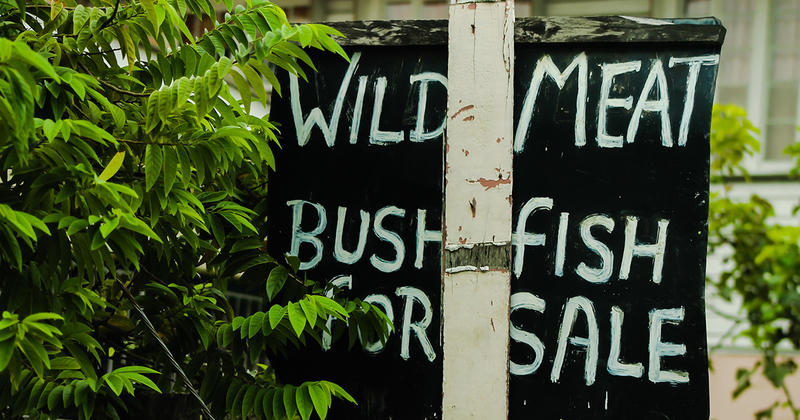
A sign advertises wild meat and bush fish for sale on Guyana’s coast.
Image: Manuel Lopez / Landscape Alliance
The Special Feature shares research from scientists in more than 12 countries across four continents to better understand how wild meat can be harvested, traded and consumed sustainably, while ensuring that benefits and costs are equitably distributed (Fig. 1). These conditions are a prerequisite for achieving Targets 5 and 9 of the GBF.
The resulting collection is a collaborative effort between the Durrell Institute of Conservation and Ecology (DICE) at the University of Kent and partners of the Sustainable Wildlife Management (SWM) Programme and the TRADE Hub (the United Nations Food and Agriculture Organization (FAO), Landscape Alliance, Wildlife Conservation Society (WCS), University of Oxford and the French Agricultural Research Centre for International Development (CIRAD). This research will also enrich two new and growing communities of practice that center on ‘sustainable use’ of wild species: The Sustainable Use of Wild Species TPP and the Central Africa Bushmeat Research Into Policy (CA-BRIP) Network.
“This shared research outcome is timely and encouraging in light of the upcoming UN Biodiversity Conference this month. Wide partnerships like these provide a solid foundation of evidence that negotiators can build on to make decisions that benefit everyone.”
– Dr Daniel Ingram, Durrell Institute of Conservation and Ecology, University of Kent.
Ways forward
The editorial synthesises research in the Special Feature into three pathways to achieve sustainability and equitability in the wild meat sector:
- Ethics and equity at the core – solutions should consider the specific context at each site and differentiate between dependence versus preference for wild meat.
- Building a bigger evidence base through monitoring and evaluation – determining the effectiveness of interventions and sharing results among practitioners and policymakers.
- Improving indicators to track progress towards achieving the GBF targets – for example by focusing on whether countries have the policy frameworks and processes in place to prevent overexploitation, minimise impacts on non-target species, reduce the risk of disease spillover, and respect, protect and support customary sustainable use in order to achieve Target 5.
“By drawing on such a diverse array of case studies, the Special Feature facilitates cross-country learning on how management interventions or broader societal changes can affect wild meat systems in different contexts, providing useful insights for inclusive decision-making processes.”
– Dr Juliet Wright, Interdisciplinary Centre for Conservation Science, University of Oxford.
“The research results presented in this issue demonstrate that wild meat lies at the intersection of wildlife and food, wildlife conservation and use, and biological and social dynamics. As such, it provides a powerful entry point for understanding these interactions and for designing more sustainable relationships between people and their environment.”
– Dr Muriel Figuié, CIRAD
See the original article from Landscape Alliance: https://www.landscapealliance.org/press/press-release/special-feature-argues-sustainable-and-equitable-wild-meat-is-key-to-achieve-gbf-targets/
To read more about this topic, see the special feature published in People & Nature: https://besjournals.onlinelibrary.wiley.com/toc/25758314/2026/8/10
Author