University of Oxford
11a Mansfield Rd
OX1 3SZ
UK

25th June 2026
10 minutes read
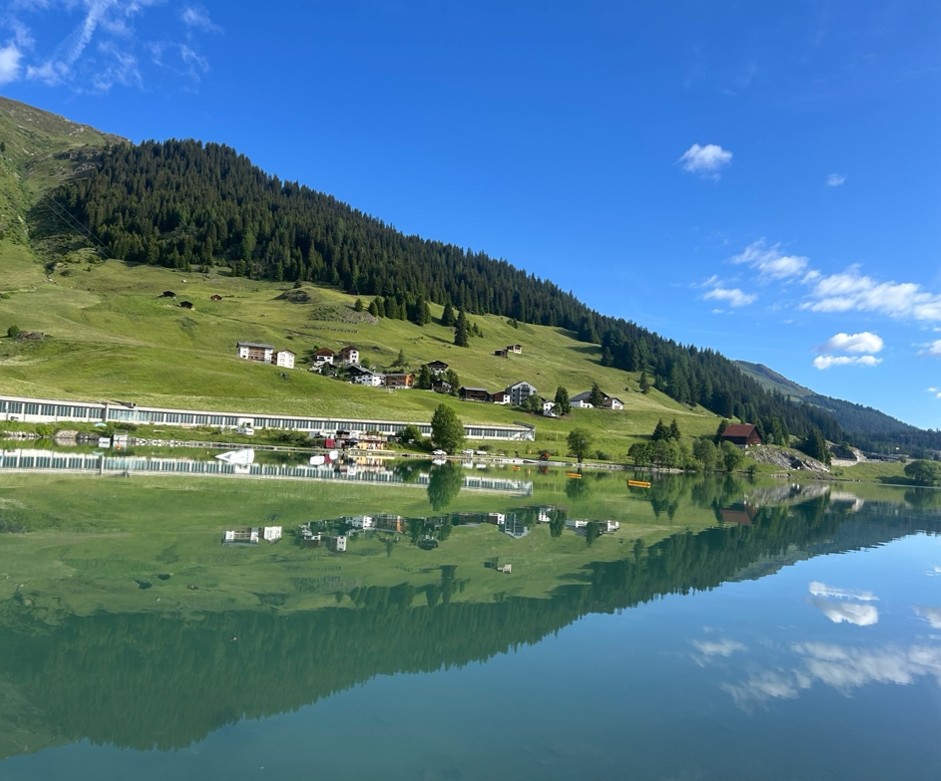
I knew Switzerland would be beautiful, but I was not prepared for the train into Davos. As we emerged from a tunnel into the Swiss Alps, the view suddenly opened onto glittering lakes, cloudless skies, and mountains that seemed to stretch endlessly upwards. I’ll admit, I let out an audible gasp! It felt like a fitting way to arrive at the World Biodiversity Forum: awed by the scale and beauty of the natural world before spending a week discussing how to protect it.
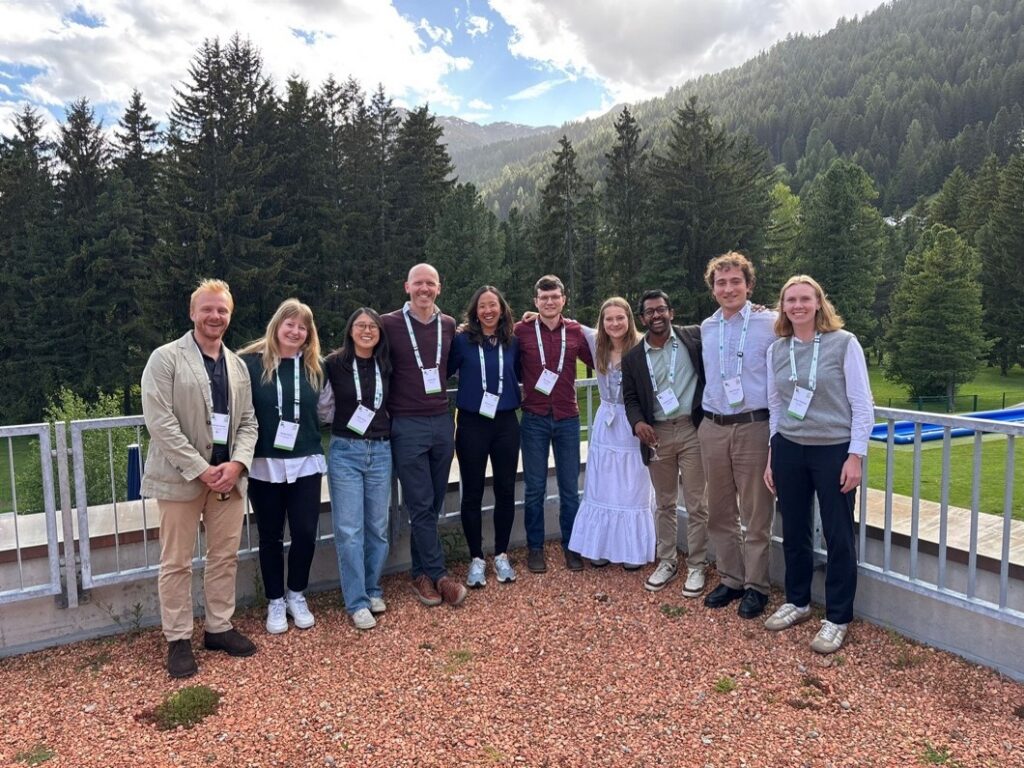
Held under the theme Leading Transformation Together, the fourth edition of the Forum brought together individuals from across science, policy, business, civil society, the arts and different generations to explore how we can bend the curve of biodiversity loss and address the interconnected planetary crises.
With the conference not beginning until the following morning, I had a little time to explore, and so after checking in, I headed straight out for a run up the hill behind our hotel. (Well, I say “run” – there was a generous amount of stopping involved, which I have chosen to blame on the altitude!). From the top, I could see right across the town, with mountains rising on every side. It was the perfect way to begin the week.
Sunday: Diving In
The Forum started bright and early on Sunday morning with a workshop on the Nature Futures Framework (NFF), focused on improving data-to-decision flows through actionable biodiversity scenarios, models, and science-policy collaboration.
The NFF went on to become one of the recurring themes of the conference and provided a useful lens through which to think about biodiversity futures. Rather than focusing solely on ecological outcomes, the framework recognises that people value nature in different ways: for its intrinsic worth (Nature for Nature), for the benefits it provides to people (Nature for Society), and for its cultural significance and relationships with people (Nature as Culture).
In the afternoon, we held our own NATURE Impacts workshop – a fantastic opportunity to engage with other participants and hear a wide range of perspectives on questions we are currently tackling as part of the project. There were, of course, a few early technical hiccups (a reminder that complex systems are not limited to biodiversity), but after some collective perseverance everything was working by the time we started – much to our relief!
We were fortunate to have Becky Chaplin-Kramer join us for an opening introduction before our team set the scene and presented on the interconnected components of NATURE Impacts, highlighting our overarching goal to support countries in identifying and prioritising actions and commitments towards global biodiversity recovery, while accounting for differing national contexts and circumstances. The second part of the workshop split into two breakout groups, one exploring how responsibility for biodiversity action should be shared between countries in ways that are both fair and equitable, and the other considering what information decision-makers need to identify national actions capable of delivering the greatest global biodiversity benefits.
Looking back, many of the points that emerged during our workshop resurfaced throughout the Forum. It was encouraging to see that many of the issues we are exploring in NATURE Impacts were also central to broader international discussions on biodiversity recovery, and the conversations that followed reinforced my sense that our work is engaging with questions of genuine global significance, and has the potential to make a meaningful contribution to this collective effort.
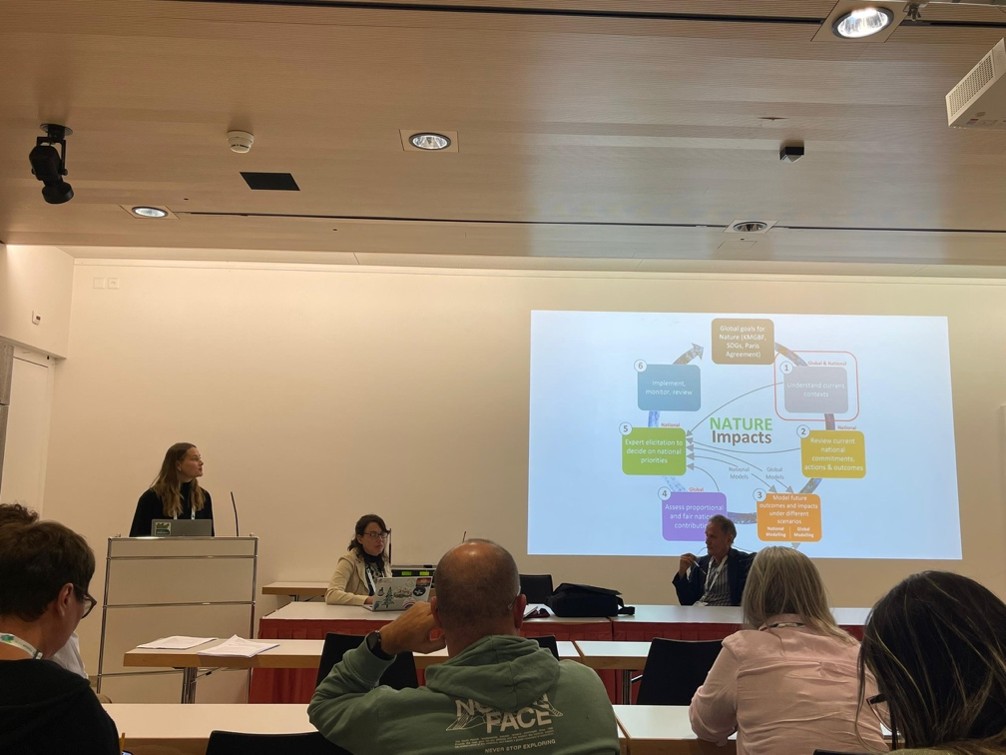
Éilish presenting on NATURE Impacts
Pulling on the threads of discussion
The Forum covered an enormous range of topics, from biodiversity finance to AI, invasive species, restoration, Indigenous knowledge, health and futures thinking. Despite this diversity, several common threads emerged.
Perhaps the most striking theme was the need to focus not only on biodiversity loss, but also on understanding and enabling recovery. This was the theme for the opening keynote by Becky Chaplin Kramer, and it set the scene for much of what followed. She highlighted that while biodiversity science has historically focused heavily on documenting decline, comparatively less attention has been devoted to understanding how recovery occurs and can be sustained. As she noted, “if we don’t know how recovery happens, how do we replicate it?”
This emphasis on understanding pathways to recovery resonated throughout the week and linked naturally to broader discussions about the importance of envisioning positive futures. Much of biodiversity monitoring focuses on documenting losses and assessing whether past actions have been effective. But transformative change requires more than measuring where we have been; it requires a clear vision of where we want to go. The Nature Futures Framework featured prominently throughout the Forum because it encourages exactly this kind of thinking, asking not only how nature is changing, but what kinds of futures for nature and people we want to build.
A second message I heard repeatedly was that the challenge of achieving a Nature Positive future extends far beyond a lack of biodiversity science. We have more models, datasets, scenarios and indicators than ever before, and a pressing challenge now is turning that knowledge into decisions and action. Discussions repeatedly returned to the idea that the barriers to progress are often less about generating new evidence and more about connecting existing knowledge to decision-making, building institutional capacity, and ensuring information is accessible and usable.
It also made me reflect on the role of academia, where, as researchers, we often tend to focus on generating knowledge and improving methods. Yet, conversations throughout the Forum – and continued at a workshop in Oxford earlier this week – highlighted how easy it can be to underestimate the realities faced by those responsible for turning evidence into policy and practice. Progress depends not only on good science, but also on understanding the practical constraints, competing priorities and institutional challenges that shape real-world decisions, and working with these tensions rather than in spite of them.
A third observation was the importance of values and participation. Across discussions on Indigenous knowledge, community-led restoration and biodiversity governance, there was a strong recognition that evidence alone rarely drives decisions. People’s values, experiences and priorities shape how biodiversity actions are understood, supported and carried out to enact long-lasting change.
What stood out was the emphasis on local communities as active partners rather than passive recipients of change. Whether discussing Indigenous-led planning, community-based monitoring or locally adapted restoration projects, speakers repeatedly highlighted that lasting change is most likely to succeed when it is locally meaningful, legitimate and shaped by those who will ultimately live with its consequences.
Finally, many sessions reinforced the idea that biodiversity cannot be considered in isolation, with discussions repeatedly linking biodiversity to climate change, finance, health, development and questions of justice. This reflected the Forum’s theme of Leading Transformation Together: achieving a Nature Positive future will depend on bringing together actors, sectors and perspectives that have too often worked separately, and this was evident not only in the discussions in formal sessions, but in the range of people I spoke to from across disciplines, sectors and cultural backgrounds.
Conversations In Between
An unexpected highlight of the week was the opportunity to discuss the NATURE Impacts project with several keynote speakers and session leads. By about the third conversation, I started to feel as though I was accidentally playing keynote bingo, but having the chance to test ideas, hear different perspectives and receive feedback on some of the questions we are exploring quickly became one of my favourite parts of the event!
One of the most valuable aspects of these conversations was that they rarely provided definitive answers. Instead, they offered new ways of thinking about familiar questions and often left me with more questions than answers. For example, a conversation with Wendy Smith challenged an assumption that often sits beneath expert elicitation exercises: that the goal should be consensus. Wendy argued that disagreement can be valuable information in itself, and that in complex systems, differing perspectives may reflect genuine trade-offs, uncertainties and tensions that need to be understood rather than resolved.
A discussion with Tanya Berger-Wolf highlighted a challenge that surfaced repeatedly throughout the week: the gap between collecting biodiversity data and translating those observations into useful metrics. Advances in technology, artificial intelligence and citizen science are allowing us to collect ecological data at unprecedented scales. However, there is often a tendency to focus either on species-level observations and indicators or on top-down global models, and the challenge is increasingly how to bridge these perspectives and move from measuring individual components to understanding entire systems. This is a question we are also grappling with within NATURE Impacts.
Many conversations also returned to the importance of grounding biodiversity action in local realities. Discussions with Nelly Masayi and Joji Cariño both emphasised that biodiversity priorities are shaped by local contexts, histories and values. In Kenya alone, ecosystems ranging from drylands to wetlands face very different challenges and require different approaches, and so, biodiversity priorities often differ not only between countries but within them.
One point raised by Nelly that I found particularly interesting was the role of culture and history in shaping conservation outcomes, and the importance of understanding how different communities relate to and communicate about nature. While international biodiversity targets and global frameworks are important, she noted that many communities conserve nature for reasons that have little to do with formal policy goals. Cultural traditions, spiritual values and longstanding relationships with landscapes can be powerful drivers of conservation in their own right. In many cases, species and ecosystems are protected not because they contribute to a global target, but because they hold cultural significance or provide benefits that communities have valued for generations.
Finally, we had a particularly thought-provoking conversation with David Boyd about human rights and the growing role of legal frameworks in biodiversity governance and nature recovery. One issue that had not previously featured in our NATURE Impacts discussions, but which immediately stood out, was the influence of sovereign debt on environmental action. In some countries, debt servicing consumes resources that might otherwise be invested in healthcare, education or environmental protection, and in some cases exceeds spending on these sectors combined. As a result, sovereign debt can fundamentally constrain what actions are feasible, shaping not only environmental policy but the broader set of priorities governments are able to pursue.
Looking back, Looking Forward
One memorable session in the week was focused on the concept of hope. This is not the belief that things will inevitably turn out well, but the decision to act despite uncertainty.
That distinction stayed with me throughout the week. While the challenges discussed were immense – biodiversity loss, climate change, governance failures, financing gaps, and competing priorities – there was also a persistent focus on solutions, collaboration, and transformation.
I quite liked a quote from one of the sessions, originally said by the American writer and activist Rebecca Solnit:
“Hope is not a lottery ticket you can sit on the sofa and clutch, feeling lucky. It is an axe you break down doors with in an emergency.”
And throughout the week, I saw examples of people doing exactly that: researchers working alongside policymakers, Indigenous communities shaping biodiversity strategies, farmers co-designing solutions, young conservation leaders creating opportunities in their communities, and businesses beginning to confront their responsibilities to nature.
The path to a nature-positive future remains uncertain, and there are no simple solutions. But if the conversations at the World Biodiversity Forum revealed anything, it is that hope is already being put into practice. Across sectors, generations, and continents, people are picking up the axe.
Author
I am very active and love to be out in the field, being lucky enough to have been a volunteer diver in Belize and a conservation intern in Nosy Be Madagascar. Both trips involved working with and learning from local people and demonstrated to me the importance of local communities leading conservation action.
I am very excited to be a part of the ICCS research group, to both work with and learn from inspiring conservation scientists, and provide my own small contribution towards an equitable and sustainable future.