University of Oxford
11a Mansfield Rd
OX1 3SZ
UK

12th November 2026
7 minutes read
On my second day in Oxford, I had lunch at Merton College, which was founded in 1264. I ate with Adroit Chakandinakira, who joined the Interdisciplinary Centre for Conservation Science (ICCS) as a Leventis Fellow at the same time as me. I remember thinking how far I was from where my own story began.
I grew up in Kajiado County, in southern Kenya, in a Maasai community where people and wildlife share the land. In 2018, still a teenager, I started Naturehub Collective with a simple belief: the people who live closest to nature are best placed to protect it. Today we work from the Indian Ocean coast to the Taita Hills and the savannas of Laikipia and Kajiado.
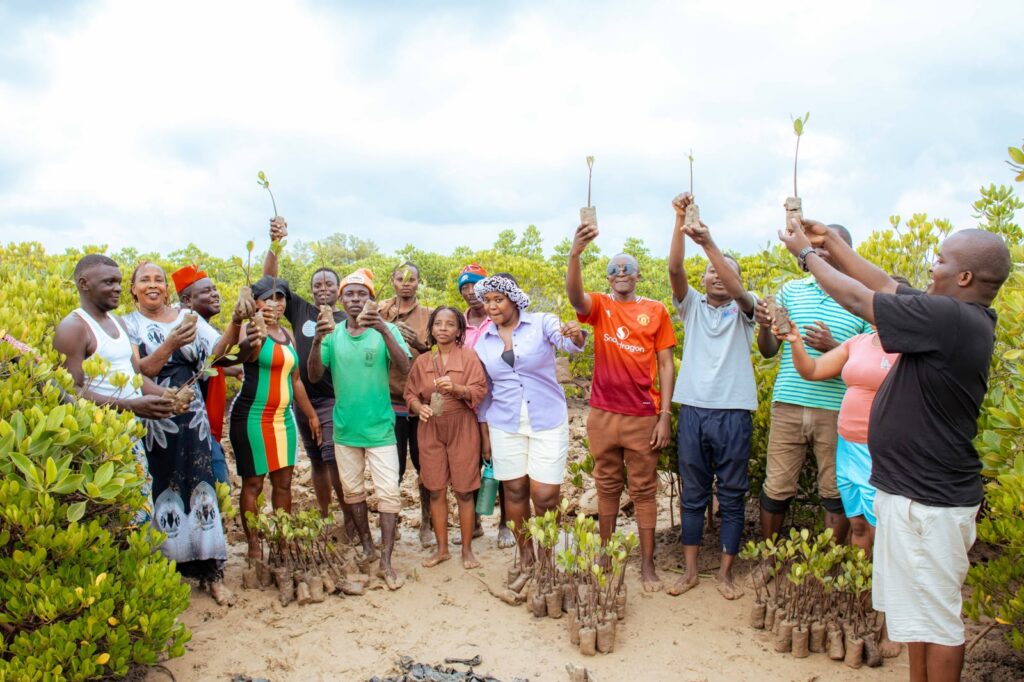
Our biggest programme is at Mtwapa Creek, on the coast. With the Kidongo Women’s Group we have planted more than 500,000 mangrove trees, and about 97 in every 100 seedlings survive. Fifteen of the women keep bees in the restored forest, and the honey they sell, Mangrove Gold, brings their families a new income.
We know it works because we see it. But seeing is not the same as proving. We keep careful records of what we plant and how it grows, but scientists, government agencies and carbon programmes ask for more, such as how much carbon the restored forest holds. So the question I carried to Oxford was simple: how do you turn what a community already knows into proof that others can trust?
The welcome from ICCS made it easy to begin. Xiaotong, my buddy and a PhD student in the group, met me off the coach on my first evening, helped me find my room and made sure I had something to eat. A week after I landed I had up to fifteen minutes to explain our work to the group at the weekly Wednesday meeting, an interactive hour held every Wednesday at 4pm. It is a quick way to learn which parts of your own story need more evidence, and I joined whenever I could.
A great deal of that welcome was down to Lucy Radford, the group’s Senior Research Facilitator. From the first emails before I travelled to the final days of my stay, she looked after the details that can make an international fellowship stressful: flights, accommodation, funds, university access, even a plan for my first few days and an introduction to Xiaotong. She answered every question patiently and was kind when family matters came up. I could not have asked for a better first point of contact.
My mentor, Professor Dame E.J. Milner-Gulland, introduced me to colleagues working on mangroves, on livelihood projects and on carbon and biodiversity credits. When I sent her a very ambitious plan, she gave me the best advice of the fellowship: do less, and spend your time with people. I took it.
One introduction led me to Tom Worthington, from the University of Cambridge, who helped develop the Mangrove Restoration Tracker Tool. We had conversations about our work. The tracker is an online tool that lets restoration projects record what they planted, what it cost and what happened afterwards, in one standard format. When I laid our own records next to it, they fitted closely. For the first time I could see a clear path to showing Mtwapa Creek’s results in a form the wider restoration world can compare and trust.
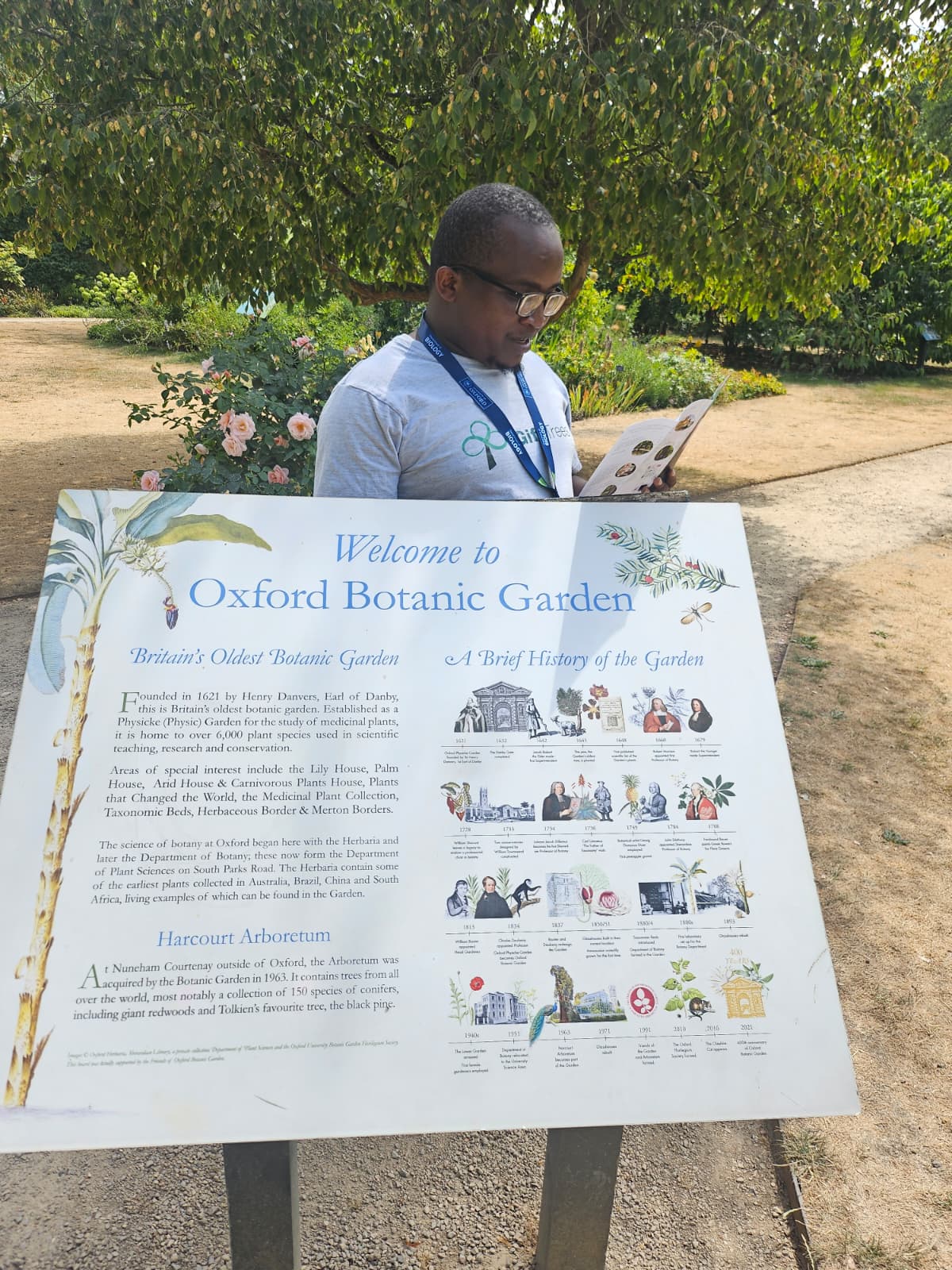
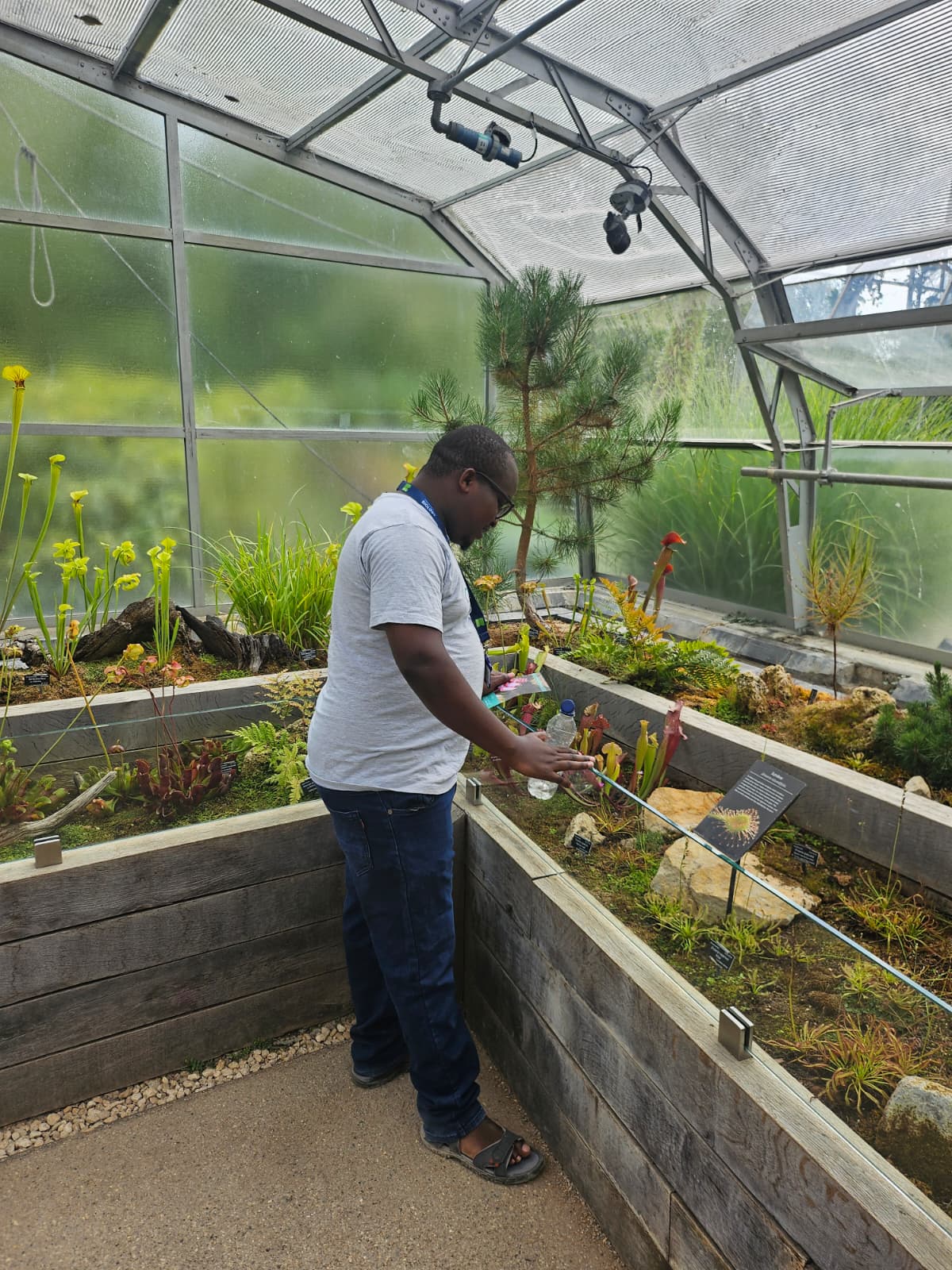
I also made a point of getting out of Oxford. I travelled to Manchester to meet one of the funders and supporters of our mangrove restoration work. In Nottingham I visited the Mojatu Foundation, and in Newark I met a friend to talk about possible support for our work. I also spent time in Reading, visited Gatwick to meet some contacts, and went to the botanic gardens in Oxford and London.
Getting around was a pleasure. Coaches, buses and trains were well organised and easy to use, so a day in Manchester or Nottingham needed no car and very little stress. And the UK is green: parks, meadows, gardens and trees almost everywhere I looked, even in the middle of cities. As someone whose work is all about trees and forests, I noticed. Both stayed with me.
Other conversations changed how I look at our enterprises. We keep bees, run fish ponds and crab farms, and build beehive fences to keep elephants out of crops. They all help, but I had rarely stopped to ask, for each one, what it is meant to change, who it helps and how we would know if it is working. Talking with colleagues who study this kind of work, including Steph Brittain, who co-wrote a practical guide to designing such projects, gave me better questions and the start of a way to answer them.
Carbon and biodiversity credits were the third thread. One of our funders suggested we look at Plan Vivo, a certification scheme for community-based carbon projects, and we began the process earlier this year. It is slow and demanding, but it could give the community a steady income from protecting the forest, and it rewards exactly the careful records I was learning to keep.
One conversation at a Wednesday meeting stayed with me too. I got talking with Helen Newing, whose work in Kenya includes human rights-based conservation and community-led biodiversity monitoring at Mount Elgon. Hearing about it first-hand gave me many insights that I can use with our own community monitoring teams.
There was good news for our Taita Hills work too. In July, the Scientific Exploration Society, a UK charity that backs scientific exploration, endorsed our Taita Endemics Conservation Project and gave me membership of the Society. It is a planned nine-month expedition, from November 2026 to July 2027, to assess three critically endangered species found nowhere else on Earth: the Taita Apalis, the Taita Thrush and the Taita Warty Frog. The Society also invited me to its Explorer Talk in London.
I will not pretend the personal side was small. For many Kenyans and Africans, Oxford is a place you see from far away and never imagine entering. I never imagined I would walk its halls, share our work with its researchers and be mentored by them. I am grateful, and I feel the responsibility that comes with it. Everything I have learned here is meant to go home.
Now the work continues at home. We are working towards putting our Mtwapa Creek records on the Tracker Tool, continuing our Plan Vivo certification process, and drafting two papers with ICCS support: one on community-led mangrove restoration, and one on livelihood projects in coastal Kenya and the Amboseli area. I also plan to enrol in University training courses in academic writing, statistics and mapping, and Lucy has kindly offered to help me get links to any courses I need that are not on the University’s system. The fellowship’s support does not end when you leave Oxford, and I plan to use it.
Thank you to the A.G. Leventis Foundation for making this possible; to Lucy Radford, who looked after every detail; to Merton College, for welcoming me to its table; to E.J. and Fran Hale for such a warm welcome; to Xiaotong and Adroit for the company; and to Tom Worthington, Thomas White, Steph Brittain and Helen Newing for their time and generosity. Thank you most of all to the Kidongo Women’s Group. Their work is the reason I had something worth bringing to Oxford.
Author
I founded Naturehub Collective Community Organisation in 2018, driven by a simple conviction: that the communities living closest to nature are best placed to protect it. What began as a small initiative has grown into a multi-landscape conservation organisation operating across coastal Kilifi, the Taita Hills, Laikipia, Kajiado County, and Mount Kenya, with over 30 funding partnerships across 12 countries.
Naturehub's core niche is marine conservation and mangrove ecosystem restoration. We work hand in hand with coastal communities — particularly the Kidongo Women's Group at Mtwapa Creek — as the primary conservation agents, not as beneficiaries of externally designed programmes. Over 500,000 mangroves have been planted under their stewardship.
Being here at Oxford still feels surreal. This institution has represented a distant dream for so many young Kenyans and Africans who grew up seeing it from afar. Coming from my background, I never imagined I would one day walk these halls. I carry that with gratitude and responsibility — everything I learn here, I intend to bring home.