
University of Oxford
11a Mansfield Rd
OX1 3SZ
UK

4th August 2026
1 minute read
A new preprint maps the current monitoring landscape across biodiversity-related commitments, including those from the Global Biodiversity Framework, the SDGs, and the Paris Agreement:
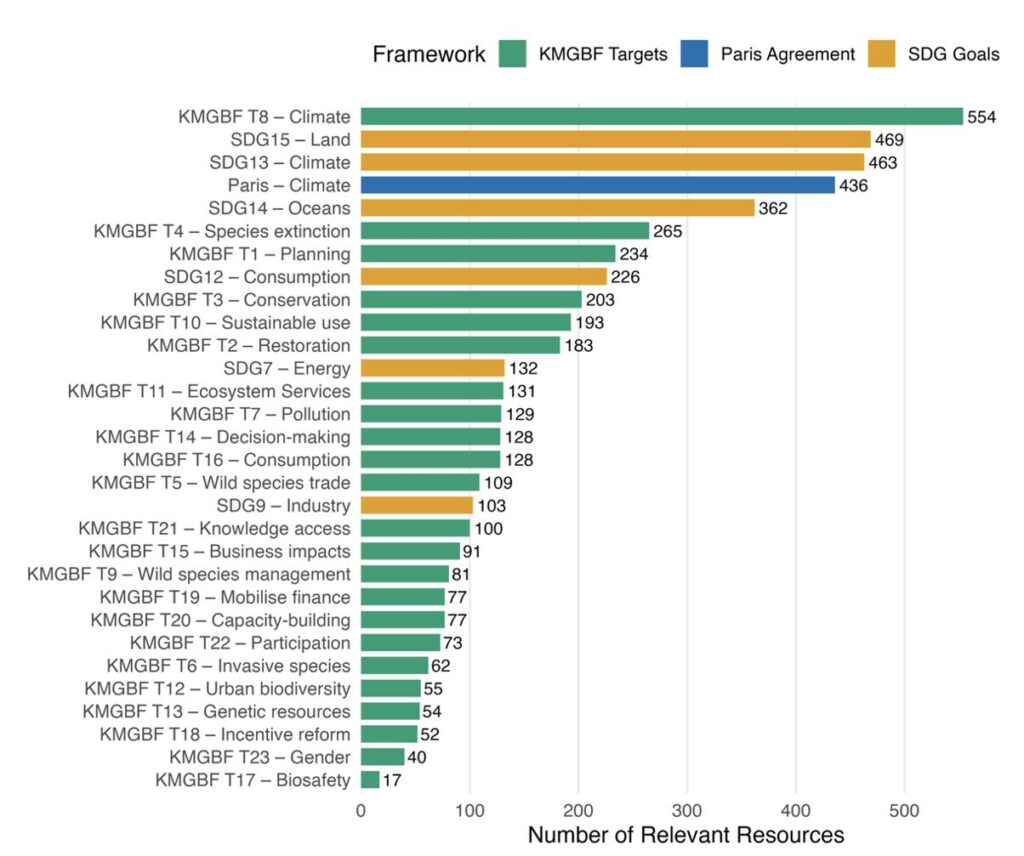
Through a systematic search of the grey and scholarly literature, we collated 1,008 monitoring resources – from peer-reviewed papers and datasets to information platforms, trackers, and reports – and mapped their relevance across 30 international commitments for biodiversity protection and recovery.
The results show both progress and imbalance:
– Every biodiversity-related commitment had at least some relevant resources.
– Coverage ranged from 17 to 554 resources per commitment.
– Climate-related commitments were the most well-supported, while biosafety, gender, incentive reform, and genetic resources had far fewer resources.
– Differences in accessibility, standardisation, and comparability make it harder to use existing resources effectively.
This work is part of the NATURE Impacts project, and it speaks directly to the project’s first two steps: bringing together ecological, social and economic evidence to understand national contexts, and assessing current action. By presenting this landscape in a structured way, we hope the paper – and the accompanying Zenodo repository – will help researchers, practitioners and policymakers identify relevant resources more quickly, support reporting and decision-making, and provide a foundation for future work.
Author
I am very active and love to be out in the field, being lucky enough to have been a volunteer diver in Belize and a conservation intern in Nosy Be Madagascar. Both trips involved working with and learning from local people and demonstrated to me the importance of local communities leading conservation action.
I am very excited to be a part of the ICCS research group, to both work with and learn from inspiring conservation scientists, and provide my own small contribution towards an equitable and sustainable future.