University of Oxford
11a Mansfield Rd
OX1 3SZ
UK
DPhil Student
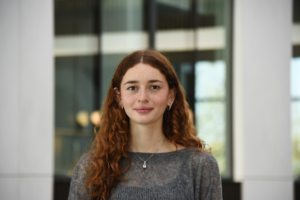
Emma Starink
Background
Research interests
I am a social scientist turned ecologist by Oxford! I spent the first five years of my higher education studying international development, with a particular emphasis on international agricultural development. I have always been interested in how food systems can work smarter and harder for the farmers and communities who steward them – without taxing the ecosystem unfairly. This interest has led me to research on GMOs, biofortified crops, and agroforestry systems, all within sub-Saharan Africa, where food systems have the most catching up to do in terms of yield, and where ecosystems are increasingly threatened by climate change.
After graduating from with my master’s degree in International Development, I moved to Madagascar for two years to put my theories to practice. I planted thousands of trees across dozens of new agroforestry systems, and found my work raised even more questions. I now seek to understand the impact of these systems on the environment and human communities around them. In my PhD I use a wide range of methods, balanced as always between the social and natural sciences!
Current research
I combine my passion for international development and biology in a project that seeks to understand how agroforestry systems in southeastern Madagascar affect the natural and human environments around them. My first chapter focuses on bats, essentially figuring out which bats are found where and what ecosystem services these species provide. I took bioacoustics data and fecal samples collected by Ricardo Rocha across forest and agriculture sites, and analyzed it to discern species richness, community composition, and diet patterns. My next chapter focuses on birds. I took hundreds of hours of acoustic data (also collected by Ricardo) and ran it through Oxford’s supercomputer. I analyzed this data to understand how bird guilds and traits differ among land-use type. I also conducted a diel analysis to see how human presence might affect bird behaviour.
In October of 2026, I will be collecting my own data in southeastern Madagascar, travelling back to the island as a Fulbright grantee. I will conduct interviews and collect surveys to understand how farming communities experience and perceive the benefits of agroforestry and biodiversity. I will also be laying camera traps, to see what I might be able to capture in terms of mammal diversity and richness across the same land-use types.
Brief CV
2018 – 2022
BS International Affairs and Biology, George Washington University
2022 – 2023
MPhil Development Studies, Cambridge University
2023 – 2025
Agriculture Extension Agent, Peace Corps Madagascar
2025 – Now
DPhil Biology, Oxford University
2026 – Now
Fulbright Madagascar Grantee