University of Oxford
11a Mansfield Rd
OX1 3SZ
UK


29th October 2026
6 minutes read
As governments gather for COP17, a new paper led by University of Oxford and WWF researchers sets out four priorities for turning global biodiversity commitments into faster, fairer and more effective action.
As governments from around the world gather for the UN Biodiversity Conference, COP17, a new paper led by researchers at the Leverhulme Centre for Nature Recovery (University of Oxford) and WWF argues that this is a critical moment to accelerate action to halt and reverse biodiversity loss.
Published in Conservation Letters, A Critical Year for Nature: Now Is the Time to Accelerate Action on the Global Biodiversity Framework discusses the state of progress since countries adopted the Kunming-Montreal Global Biodiversity Framework in 2022. Whilst much positive action has been delivered as a result of these ambitious goals set out in the framework, the authors warn that progress so far remains highly insufficient, while biodiversity continues to decline and the risks of irreversible ecological tipping points grow.
“COP17 is a crucial moment for nature, bringing together parties to assess the progress since the game-changing targets set under the Global Biodiversity Framework in 2022. While progress has been made in some areas, much more needs to be done. Now is the time to accelerate global biodiversity action and address the ongoing crisis.”
The paper identifies four key needs that could help countries move from commitments towards faster and more effective action for nature.
1. Independently track action and outcomes, not just commitments
The authors argue that greater transparency is needed about what countries are actually doing to implement their biodiversity commitments. This means understanding which policies have been adopted, how they are being implemented, what resources are available, what barriers countries face, and ultimately whether policies are delivering the outcomes needed for nature.
An independent mechanism for tracking implementation would complement formal reporting under the Convention on Biological Diversity, while creating opportunities for countries (and actors within countries e.g., businesses, community groups) to learn from one another about what works in practice.
2. Prioritise the actions that can have the greatest impact
Countries differ substantially in their ecological, social and economic contexts, as well as in their capacity to act. The paper argues that biodiversity action therefore needs to be prioritised according to where countries can make the greatest contribution to global nature recovery. We need to take a ‘forward-looking’ approach to prioritizing the most effective future action, and not just backward looking assessments of progress as has often been the case up until present.
Crucially, this requires looking beyond national borders, and considering the international impacts of action and inaction. Consumption, trade, supply chains and financial flows in one country can have major impacts on biodiversity elsewhere. National action, and prioritization exercises that assess where to spend limited funds, should therefore consider both domestic biodiversity and countries’ wider global footprints.
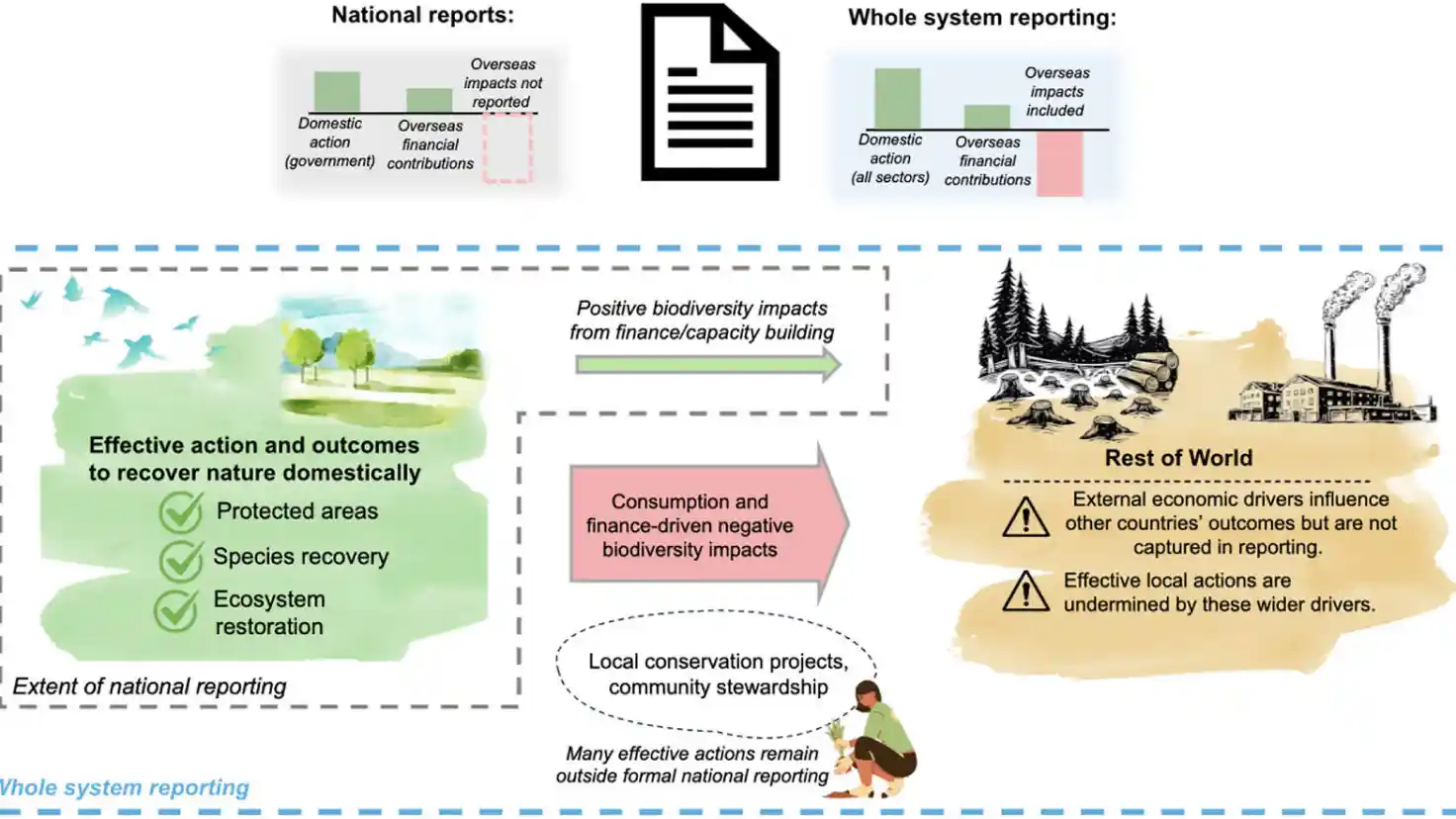
A hypothetical example of the need for whole-system reporting to capture a country’s overseas impacts.
“The impacts of biodiversity loss are not evenly distributed between countries or parts of society; some are very much worse affected than others. The same goes for the distribution of the activities that damage or restore nature, and capacity to act for nature. NATURE Impacts aims to make these difficult issues more transparent, so that decision-makers can explore ways to more fairly apportion the efforts needed to recover nature.”
3. Make biodiversity action a whole-of-society effort
Governments are central to delivering the Global Biodiversity Framework, but they cannot do it alone. Indigenous Peoples and local communities, businesses, researchers, civil society and sub-national governments are already taking actions that contribute to global biodiversity goals, yet many of these efforts are not systematically captured in national reporting or prioritization exercises.
The authors call for broader and more transparent dialogue that acknowledges actions across society, enabling lessons to be shared, contributions to be recognised, and positive and negative impacts to be better linked together and understood.
“Halting and reversing biodiversity loss requires a whole of society approach to address the underlying drivers of change and develop effective solutions. This includes engaging local communities, indigenous groups, businesses, financial institutions, sectoral bodies and government at all scales – and working together to develop linked-up, actions that deliver for nature” Dr Thomas White, Research Fellow, Leverhulme Centre for Nature Recovery
4. Put context-specific science at the heart of decisions
Finally, countries need better scientific evidence to help decide which actions to prioritise. Rather than relying solely on global analyses, the authors call for context-specific, national-scale assessments that can compare different policy options, including their likely biodiversity impacts, costs and implications for biodiversity overseas.
The paper argues that modelling and scenario analysis at a national scale is needed to support decisions even in the face of uncertainty, helping countries identify actions likely to deliver positive outcomes across a range of possible futures, and accounting for the international effects of national-level action.
Turning these needs into action
The paper highlights two initiatives under development that could help respond to these needs: the Nature Action Tracker, an independent platform being developed to track and assess implementation of the Global Biodiversity Framework, and NATURE Impacts, led by WWF-UK and the University of Oxford, which is developing approaches to help countries identify and prioritise actions that could make the greatest contribution to global nature recovery. Work on NATURE Impacts has been supported by the Leverhulme Centre for Nature Recovery and WWF.
“As highlighted in the recent Living Planet Report, we know it is possible to turn the tide and help species and ecosystems recover. But doing so at the scale and pace needed will require more than isolated successes, we need to see fundamental changes to the systems driving nature loss, particularly how we produce food, how finance is directed, and how we generate and use energy. We also need a step-change in how we assess progress, set priorities and drive action across these systems. We hope the needs outlined in this paper, together with our NATURE Impacts project, can help catalyse the action needed to bend the curve of biodiversity decline.” Dr Mike Barrett, WWF-UK
Header image copyright © University of Oxford Images / Elizabeth Lettmann — All rights reserved.
Author
I am very active and love to be out in the field, being lucky enough to have been a volunteer diver in Belize and a conservation intern in Nosy Be Madagascar. Both trips involved working with and learning from local people and demonstrated to me the importance of local communities leading conservation action.
I am very excited to be a part of the ICCS research group, to both work with and learn from inspiring conservation scientists, and provide my own small contribution towards an equitable and sustainable future.
Author
I also have several years of experience in environmental consultancy where I have developed a particular interest in the role of the private sector in addressing their negative biodiversity impacts, and in delivering conservation action. This has recently formed a large proportion of my work, and I continue to work part time at The Biodiversity Consultancy, to help develop collaborative research projects that cross the research-practice boundary.
Author
E.J. Milner-Gulland is Tasso Leventis Professor of Biodiversity at the University of Oxford. Previously she was Professor of Conservation Science at Imperial College London, and she has also held lectureships in Resource Economics and Mathematical Ecology. Her PhD, at Imperial College London, was on the wildlife trade, with a focus on ivory, rhino horn and saiga antelopes. Her research group, the Interdisciplinary Centre for Conservation Science, undertakes a wide range of research, outreach and engagement projects, on five continents and in both marine and terrestrial settings. These include developing and applying methods for understanding, predicting, and influencing human behaviour in the context of local resource use in developing countries, and working with businesses to improve their environmental and social sustainability. Her team also works on controlling the illegal trade in wildlife and on designing, monitoring and evaluating conservation interventions in order to improve their effectiveness. She aims to ensure that all the research in her group is addressing issues identified by practitioners, and is carried out collaboratively with end-users, and builds the capacity of young conservationists, particularly in developing countries. She is the founder and chair of the Saiga Conservation Alliance and has launched a number of initiatives which aim to change the real-world conversation around conservation, including the Conservation Hierarchy approach to meeting a global vision of restoring nature and the Conservation Optimism movement. She is the Chair of the UK Government's Darwin Expert Committee and a Trustee of WWF-UK
Finally, I am passionate about the conservation ecology of the saiga antelope in Central Asia, and co-founded the Saiga Conservation Alliance in 2006.
Author
She is currently a Schmidt AI in Science Fellow in the Department of Biology and Senior Research Associate in Food Metrics and Biodiversity at the Smith School of Enterprise and the Environment. Her research combines machine learning, environmental impact assessment, and large-scale data integration to develop practical tools for sustainability research and decision-making.
Talitha has a diverse academic background spanning physics, biodiversity conservation, bioinformatics, and GIS spatial analysis. Prior to her current work, she conducted research on biodiversity footprinting, nature-positive strategies, conservation monitoring, and remote sensing approaches for habitat mapping, collaborating with organisations including Rewilding Britain, WWF UK, and the Wildlife Trusts. She continues to contribute expertise in biodiversity metrics, nature-positive frameworks, and environmental data accessibility through collaborations with international research and NGO policy teams.
Author