University of Oxford
11a Mansfield Rd
OX1 3SZ
UK
17th February 2026
5 minutes read
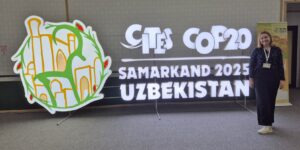
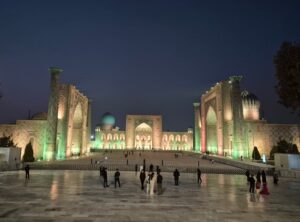
Last November, I travelled the furthest east I’d ever been to Samarkand, Uzbekistan, for CITES (Convention on International Trade in Endangered Species of Wild Flora and Fauna) CoP20. These CoPs happen every three to four years, bringing together experts from around the world to make decisions about whether and how species should be traded globally.
CoP20 was extra special as it marked CITES’ 50th anniversary, sparking reflection on the progress the Convention has made. It was also the first CITES CoP to be held in Central Asia, with Samarkand being a major hub on the ancient Silk Road.
Since first hearing about saiga horn in one of E.J.’s lectures, I’ve become a bit obsessed with the wildlife trade, so I was extremely excited to attend CITES CoP as part of my MBiol project.

A big moment for saigas
I was there to spread the word about my MBiol project – a horizon scan on the saiga antelope. This work involves gathering the perspectives of a broad group of experts to identify emerging threats and opportunities which may impact saigas over the next decade.
CoP20 had an agenda item with potential to change the game completely for saigas: a proposal to resume limited legal trade of saiga horn from Kazakhstan. International commercial trade of wild saiga specimens was completely banned in 2019 after a mass die-off in 2015 caused near-extinction, but the species has since made a remarkable recovery. Some populations are now so large that they are causing conflict with local communities, who aren’t receiving compensation, leading to a push for sustainable use.
With this huge (and controversial) decision on everyone’s minds, the importance of the horizon scan was very clear, making it the perfect time to recruit participants for my research. 
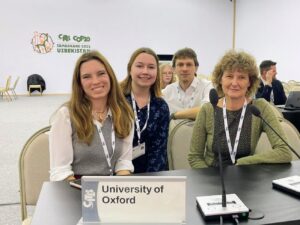
We spent the week eagerly awaiting the saiga agenda item, passing the time in the large decision-making rooms: Committee I, where proposals to change if and how species can be traded are debated, and Committee II, which focuses on how the Convention is implemented. The range of issues discussed was huge, spanning everything from sea cucumbers to rhinos.
Though sometimes a little tedious and confusing, it was interesting to see how these negotiations worked, and surprisingly tense when controversial proposals would go to a vote. Typically, the saiga agenda item came up when we weren’t even at the convention centre, so we crowded around the livestream in our hotel lobby with E.J. translating the Russian for us. After deliberating over technicalities and wording, Parties voted to allow a limited export quota of saiga horn from Kazakhstan, marking a key shift in saiga conservation.
Side events
There was a packed agenda of talks going on between Committee sessions, on a huge range of topics (I would have gone to them all if I could!). I learned about big cat reintroductions in Central Asia, CITES’ effectiveness, alligator ranching, and even went to an awards ceremony for rangers.
We also successfully hosted our own saiga side event, where Ruth Arnold (a previous ICCS student) presented her MBiol work and I advertised mine.

Exploring Samarkand
When we weren’t at the convention centre, we took every opportunity to explore Samarkand.
Highlights included trying lots of new and interesting foods (special mention to chocolate potatoes and Georgian khinkali dumplings), bartering for kilos of fruit and nuts at the bazaar, and lots of lovely walks.
I was shocked to see that some tourist shops had saiga horn knives on full display!
Reflections
When we first arrived at CoP20, I found it quite overwhelming. CITES seemed to have its own language with random inf. doc numbers and jargon being thrown around, and everyone seemed to already know each other.
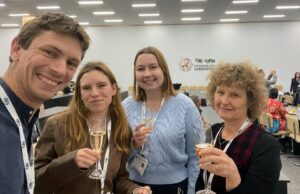
But it didn’t take long to realise that everyone was very keen to have a chat and meet new people. It became clear that the knowledge exchange and networking that goes on at these CoPs is almost as important as the decision-making.
One thing I didn’t fully anticipate was how politically and emotionally charged the space could be, given the diversity of views among attendees on the use of wildlife.
This became apparent in overheard reactions to discussions and decisions, and in moments of unexpected controversy – including debate over whether people should be allowed to clap when a proposal to uplist a species was accepted. CoP was also clearly a space for relationship-building. Often, Parties would speak on proposals that had little direct relevance to them, using these moments to publicly show support and strengthen alliances.
I’m extremely grateful to the Saiga Conservation Alliance and University of Oxford for the opportunity to attend CoP20. I feel very lucky to have experienced a CITES CoP, and I’d jump at the chance to attend another one.
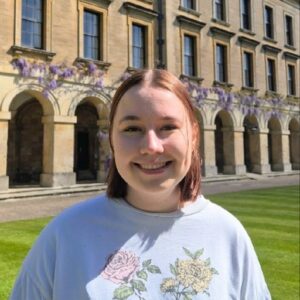
Author
I have a real soft spot for weird and underappreciated species, so I was immediately drawn to an MBiol project on the saiga antelope. Recently, I’ve spent a lot of time answering the question, “What’s a saiga?”, which I love, because it gives me an excuse to show people a picture of one. The project ties in well with my interest in the wildlife trade, and in finding ways to conserve species without compromising people’s livelihoods.