University of Oxford
11a Mansfield Rd
OX1 3SZ
UK
20th October 2025
7 minutes read
Last week, as part of the NATURE Impacts project, a collaboration between Oxford, WWF-UK and WWF Colombia, I travelled to Abu Dhabi for the IUCN World Conservation Congress 2025. This Congress is held every four years, gathering more than 10,000 people from around the world, including Indigenous leaders, government ministers, scientists, activists, and students. All are united by a shared goal: to protect and restore nature, for people and the planet.
The trip started early on Wednesday morning, at 5:30 a.m., and flying out with Stefania Karlsdottir, who also works on the project, I was full of anticipation (and caffeine!). I’d never been on a plane so big before — it even had showers upstairs, apparently. Meanwhile, I was just excited about the free coffee. By chance, I ended up sitting next to a woman from National Geographic who asked about the NATURE Impacts project, and so before we’d even taken off, the networking had already begun. It was an unexpected yet fitting start to what promised to be an inspiring week.
Kicking off the congress
The next morning after a buffet breakfast — during which we may or may not have single-handedly reduced the hotel’s watermelon supply — we made our way to the Abu Dhabi National Exhibition Centre (ADNEC), where the conference was held. The opening ceremony was inaugurated by His Highness Sheikh Khaled bin Mohamed bin Zayed Al Nahyan, Crown Prince of Abu Dhabi, and featured speakers from all around the world, including President Surangel Whipps Jr. of Palau, Her Royal Highness Princess Lalla Hasna of Morocco, Dr Sylvia Earle, and Elizabeth Maruma Mrema.

The opening ceremony on 9th October
Throughout the week, each day began with a plenary session, followed by dozens of parallel talks covering a remarkable range of topics; from nature finance and conservation funding, to gender justice and the importance of inclusive, locally led conservation. These discussions took place across various themed pavilions, including Reimagining Conservation, Pavilion France, and IUCN Africa.
Meanwhile, conversations buzzed in every corner of the venue, often sparked by ideas and questions raised during the sessions. It was both energising and a valuable lesson in navigating such a dynamic, international event. There was also a moving tribute to Dr. Jane Goodall, whose lifelong work and message has inspired generations of conservationists.
Stepping out of my comfort zone
One of the biggest highlights for me was stepping out of my comfort zone to ask questions during several sessions. At a panel in the Nature Positive Pavilion on how footprint-based industries (particularly mining) can align with Nature Positive goals, I asked how large organisations such as universities might encourage these companies to act. This question linked directly to my own research on supply chains and a paper I’m currently writing.
Later, in another session titled “Cultivating Sustainability Through Integrated Action,” I asked David Obura from IPBES about the feasibility of creating networks to support bottom-up leadership in conservation, and how such collaboration could help scale local initiatives to global impact.
Another memorable moment came when the preprint of a paper I co-authored, led by Ashley Bang and presented by Dr. Laura Sonter from The Biodiversity Consultancy, appeared on the screen during a session. Seeing our research represented in such a global forum was a meaningful reminder of how our work contributes to the wider conservation conversation.
Turning dialogue into action
One of the most important outcomes of the IUCN World Conservation Congress 2025 is the passage of formal motions that sets IUCN’s priorities for the next four years. In total, 147 motions were agreed, with 97 approved through electronic voting, and the rest decided through discussions and plenary votes. Many motions focused on strengthening protections for ecosystems, such as combating unsustainable tourism and safeguarding seamounts, to help deliver the ‘30×30’ target of the Kunming-Montreal Global Biodiversity Framework. Others tackled issues like integrating One Health principles into conservation, cracking down on environmental crime, and setting global guidelines for the wildlife pet trade. A particularly significant milestone was the adoption of a new IUCN policy on synthetic biology after years of debate, alongside motions on fossil fuel phase-out, wetlands restoration, and Indigenous leadership in conservation. Whilst not legally binding, these decisions carry both moral and political weight—shaping global conservation priorities and driving action beyond the conference halls.
Building connections
The Congress was also a great opportunity to meet people working at the forefront of conservation. Stefania and I had engaging conversations about the NATURE Impacts project with Jon Paul Rodrigues, Chair of the Species Specialist Group (SSC) at the International Union for Conservation of Nature; Domitilla Raimondo, Threatened Species Programme Manager at the South African National Biodiversity Institute; Erin Billman, executive director at Science Based Targets for Nature (SBTN); and Katharine Hayhoe, Chief Scientist at The Nature Conservancy. Each offered valuable insights and ideas for the future direction of the project.
It was also exciting to get the chance to listen to some of our colleagues from Interdisciplinary Centre for Conservation Science, including Rachel Martin, Michelle Anagnostou, Lessah Mandoloma, and Helen Newing, who spoke at a variety of pavilion events.

Presenting NATURE Impacts
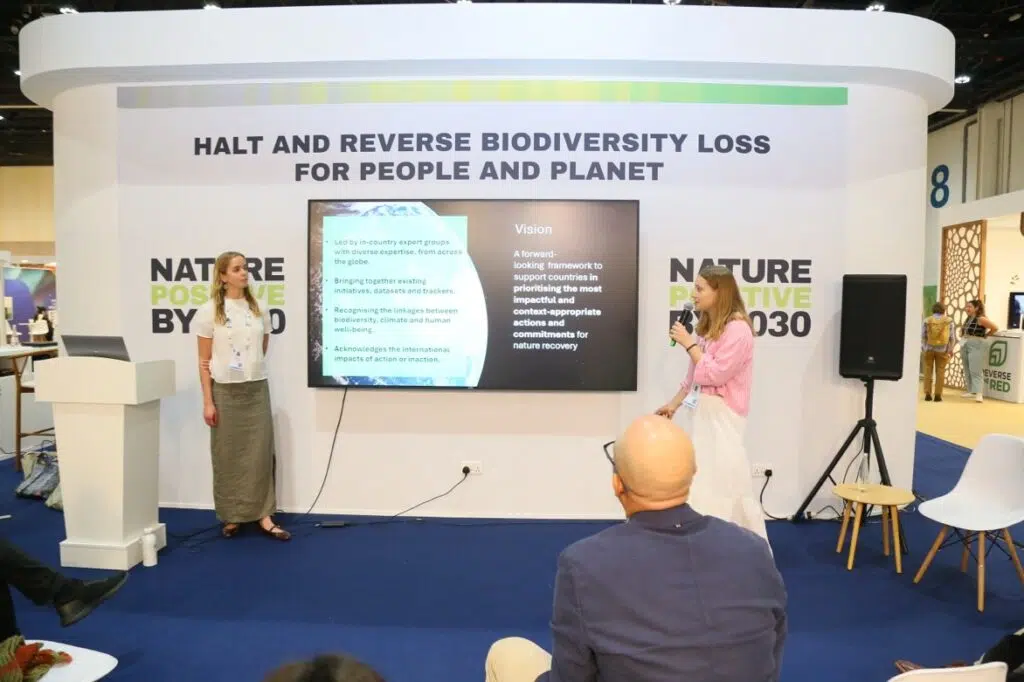
Presenting NATURE Impacts
On the final day, Stefania and I had the privilege of presenting our work at the Nature Positive Pavilion, alongside Carlos Mauricio Herrera from WWF Colombia and Noelle Kumpell from BirdLife International, who shared a complementary project called the Nature Action Tracker. In our presentation, we introduced the NATURE Impacts project (a collaboration between the University of Oxford, WWF-UK, and WWF Colombia), outlining what our pilot year has involved, the long-term vision, and inviting feedback from the audience.
The project aims to identify high-impact opportunities for nations to help halt and reverse global nature loss by 2030. Building on existing tracking initiatives, it focuses on highlighting the most effective future actions countries can take, whilst recognising national differences and the importance of bottom-up approaches. Presenting at the congress was a rewarding chance to share the project and its vision with an international audience and to contribute to the wider conversation on advancing Nature Positive action.
Exploring Abu Dhabi
Outside of the conference, there were plenty of small but memorable moments: exploring a research vessel during an evening event, sampling endless varieties of hummus at a rooftop restaurant (a level of commitment to chickpeas I deeply respect), visiting Sheikh Zayed Grand Mosque, and discovering that dates in Abu Dhabi come in dozens of types, beautifully arranged like chocolate boxes. I also squeezed in a bit of adventure — kayaking through mangroves and, a first for me, standing up while desert surfing! These experiences were a fun and energising break from the busy conference days and a chance to see Abu Dhabi from a completely different perspective.

Kayaking in mangroves
Reflections
Whilst slightly exhausted and now running mainly on caffeine as I travel home, I’m leaving Abu Dhabi feeling inspired and energised. Attending the IUCN Congress was both an incredible learning experience and a confidence-building one. It offered a unique opportunity to see the scale of the global conservation community, ask questions, take part in discussions, as well as share and gather feedback on our own work.
What stood out most was how open people were to exchanging ideas. From senior conservation leaders to early-career researchers, everyone was there to collaborate and learn from one another. I left feeling proud to play a small part in this movement—more connected to the global conversation on nature, more aware of how our contributes, and more hopeful about what we can achieve together to protect and restore the natural world.
Author
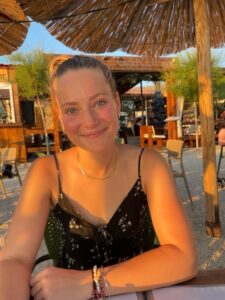
I am very active and love to be out in the field, being lucky enough to have been a volunteer diver in Belize and a conservation intern in Nosy Be Madagascar. Both trips involved working with and learning from local people and demonstrated to me the importance of local communities leading conservation action.
I am very excited to be a part of the ICCS research group, to both work with and learn from inspiring conservation scientists, and provide my own small contribution towards an equitable and sustainable future.